


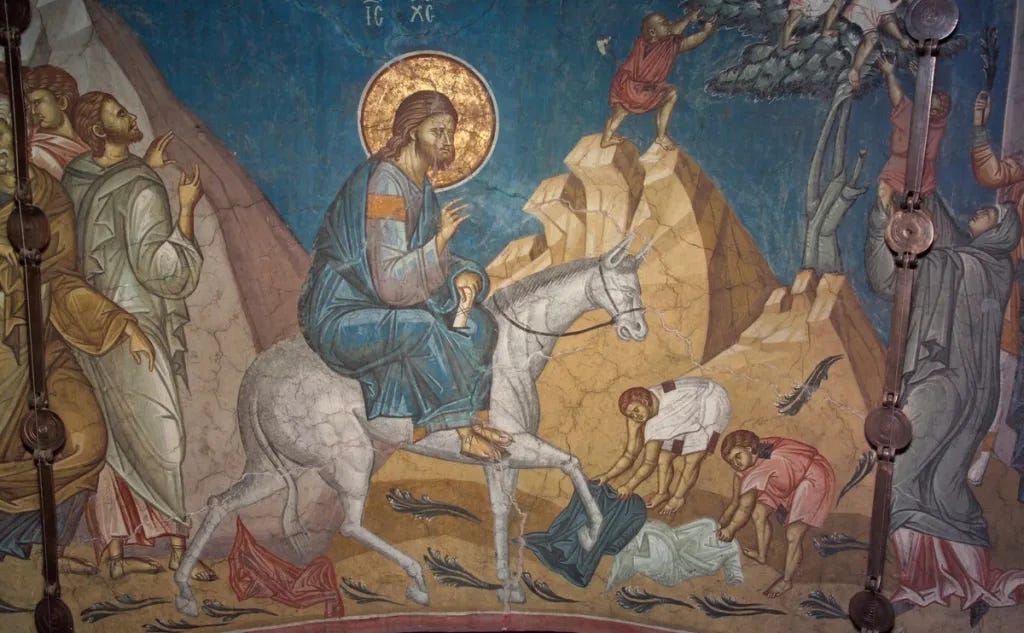
My brothers and sisters, we have once again concluded the course of the Great Fast, and entered into this joyous and triumphant weekend which the Church interposes between the struggles of Great Lent and the sorrows of Holy Week. Yesterday we celebrated Lazarus Saturday, on which the Lord Jesus Christ resurrected Lazarus the Four Days Dead. This was a feat far greater even than His earlier resurrections of the son of the widow or the daughter of Jairus, for each of those had died but recently, while Lazarus himself was already buried and rotting in the tomb. The fact that Christ raised Lazarus was without doubt the greatest proof of His divine power which He had yet showed to the people of Israel; and indeed, this miracle led directly to the events of today’s feast, as we have just heard read from the Gospel of John: “Much people of the Jews therefore knew that he was there: and they came not for Jesus’ sake only, but that they might see Lazarus also, whom he had raised from the dead” (John 12:9).
In fact, these two feasts — Lazarus Saturday and Palm Sunday — are uniquely conjoined to one another in the liturgical rites of the Church. The same festal troparion is shared by both feasts. Yesterday on Lazarus Saturday, the resurrectional service of Sunday was sung in advance: the resurrectional Evlogetaria and “Having beheld the resurrection of Christ” were sung during Matins, and the Sunday dismissal was likewise given at the conclusion of yesterday’s Saturday Divine Liturgy. Because although Lazarus himself was the one who was raised from the dead, nevertheless it was as Christ said: “I am the resurrection, and the life: he that believeth in me, though he were dead, yet shall he live” (John 11:25). The resurrection of Lazarus was the beginning of the resurrection of Christ, and so the Church begins already to sing the Sunday resurrectional service on Lazarus Saturday. The closest parallel to this unique liturgical phenomenon of which I can think is Bright Week itself, during which each day is considered to be a part of the one eternal and Eighth Day of Pascha.
It seems to me that through these things, the Church is teaching us that we cannot rightly understand today’s feast of Palm Sunday without meditating deeply upon yesterday’s feast of Lazarus Saturday. There are, of course, nearly limitless layers of meaning and spiritual knowledge contained within both these feasts. But for now, let us focus on only a few brief words from the account of these holy days written in the Gospel of John. In my opinion, these few brief words are the most poignant in the whole of the Gospels: “come and see.”
This short phrase appears only three times in the Gospel of John. Twice it occurs in the very first chapter: first when the disciples ask Christ: “where dwellest thou?” (John 1:38), and afterward when Nathanael asks Philip: “Can there any good thing come out of Nazareth?” and Philip replies in turn: “come and see” (John 1:46).
With what blessed simplicity does this phrase call forth faith, and hope, and love toward the Lord Jesus Christ! God Himself calls out with these words to each one of us, through His Son and through His Son’s holy apostles: “come and see.” If any of our hearts yearn for truth and goodness, for meaning and beauty, for peace and mercy and love, then all we need do is to “come and see” all of these things and more shining in the face of our Lord Jesus Christ.
But there is a third time that the Gospel of John contains the words “come and see.” We heard these words in yesterday’s Gospel reading as Mary and Martha and the Jews mourned over Lazarus, the friend of Christ already four days dead, and Christ asked where the dead man lay: “Lord, come and see” (John 11:34). When God speaks these words to men, He speaks of peace and joy and life unending. But when man speaks these words to God, he speaks only of the misery and decay and death which our innumerable sins have brought upon both ourselves and the whole of God’s creation. “Come and see.” Small wonder, then, that the third and final repetition of these words was followed one of the most famous verses in all of Scripture: “Jesus wept” (John 11:35).
Yet Jesus did come, and He did see, and He there wrought a miracle more glorious than any in all the history of the world until that time. He proved in very truth the words He had just spoken to Martha: “Said I not unto thee, that, if thou wouldest believe, thou shouldest see the glory of God?” (John 11:40). And so even the tragic inversion of those uniquely poignant words, “come and see,” is transfigured into unspeakable joy by our Lord Jesus Christ, Who alone is the resurrection and the life.
In the Gospel of John, there is no further repetition of the words “come and see.” But I think that the Church Herself calls these words out to us all once again on today’s feast of the Entry of the Lord into Jerusalem, on the eve of Holy Week. Come and see: Christ enters triumphant into the Holy City, the King of Israel, the Conqueror of Death, the Son of the Living God. Yet the King of Glory is arrayed not in the royal purple, but in the vesture of poverty; He arrives not in pomp and glory, but riding on a lowly donkey borrowed from a local villager. And though the gathered throngs shout “Hosanna” and hail Him as their king, nevertheless He knows all too well that in a few short days, those same crowds will cry out bitterly renouncing Him and demanding His crucifixion.
“Come and see.” Come and see not only the humility of Christ, but also the humility to which He calls each one of us. Come and see not only the suffering of Christ, but also the suffering which unavoidably awaits every single person who claims the name of “Christian.” Come and see not only the Cross of Christ, but also the crosses which we ourselves must take up for His sake. Come and see not only the love of Christ, but also the infinite, self-emptying, divine love which can utterly suffuse the lives even of such sinners as you and me — the love which alone can make us gods by grace. Come and see not only the resurrection of Christ, but also the resurrection which He has prepared for us and for all His children, even from “before the foundation of the world” (Eph. 1:4).
“Come and see.” These few simple words are the only map we need to find the road to salvation and life eternal in the Lord Jesus Christ. So on this great and glorious feast day, throughout this Holy Week, and especially on the Paschal Day itself, let us resolve above all else to heed this call from Christ in His Holy Gospel, and let us become obedient to the exhortation of St. Paul to
lay aside every weight, and the sin which doth so easily beset us, and… run with patience the race that is set before us, looking unto Jesus the author and finisher of our faith; who for the joy that was set before him endured the cross, despising the shame, and is set down at the right hand of the throne of God. (Heb. 12:1-2)
For our Lord Himself has promised: “where I am, there shall also my servant be” (John 12:26). Amen.
Yes, thank you, for this beautiful homily
Thank you