


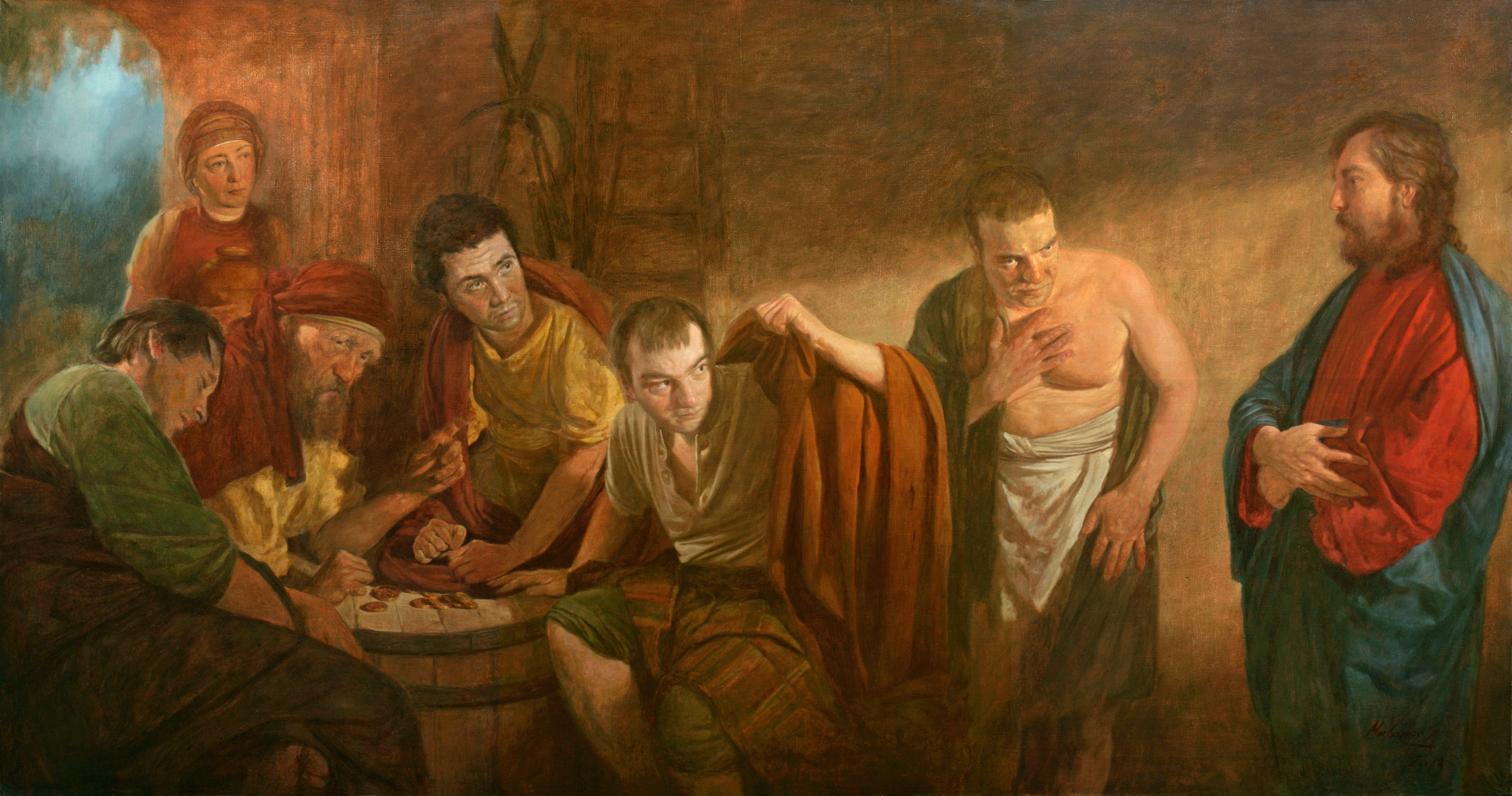
My brothers and sisters, we have just heard the Parable of the Vineyard concerning those wicked husbandmen who were entrusted with its care by the Lord, but who in the end chose to betray not only such a great and awesome trust, but even the Lord God Himself.
The Holy Fathers give us a clear interpretation of the symbolism of this parable, as it applied to those to whom Christ spoke it during His earthly ministry. The lord of the vineyard is, of course, God Himself. The vineyard is the nation of Israel, God’s chosen people; the hedge is the Law, given to protect the people of God from sin and corruption; the winepress is the altar; the tower is the Temple; the husbandmen themselves are the religious leaders of the Jews. Particularly interesting is the interpretation given to the householder’s journey into “a far country” (Matt. 21:33): according to Blessed Theophylact, “the departure of God into a far country is His long-suffering; for when He is long-suffering and not in hot pursuit of wrongdoers, demanding an account, He appears to be asleep or absent on a far journey.” The other elements of the parable are quite easy to interpret: the servants whom the householder sent to the husbandmen are the Holy Prophets, while the householder’s son — whom the wicked husbandmen cast out and slew — is, of course, the Lord Jesus Christ Himself.
Yet we must never be satisfied with the first and most obvious interpretation of Christ’s parables; we must always keep in mind that they were spoken not only to those physically present to hear His words, but also to each and every one of us as well. We must always look for ourselves in every verse of Scripture, seeking how to apply these divine and salvific words to our own lives in particular. Where, then, are you and I to be found in the Parable of the Vineyard?
On one level, we Christians are of course the “other husbandmen” (Matt. 21:41) of the Israel of God (cf. Gal. 6:16), to whom God gave the care of His vineyard after the nation of the Jews proved themselves unworthy by their rejection of Christ. Yet on another level, we ourselves must take great care lest this parable turn out to have been spoken not only against the Jews, but against us as well. After all, God by no means appointed us as husbandmen of His vineyard due to our own innate virtues or qualities or worthiness — no, we owe absolutely everything we have to the free gift of God. Yet we can see from this parable how easy it is to forget that nothing in our lives — not even our very life itself — truly belongs to us. We can see from this parable the tragedy which inevitably results when we cling selfishly to anything at all — in this world or the next — rather than rendering back to God the fruits of all the countless good things which He has entrusted to us.
And this parable warns us especially that soul-destroying attachments can indeed develop not only toward the material world, but even toward the spiritual realm as well. Last Sunday, we heard of the rich young man who could not bring himself to follow Christ because of his attachment to his outward possessions; today, we hear of the spiritual men who conspired to kill Christ because they came to view even the Kingdom of Heaven as something fundamentally belonging not to the Lord, but to themselves. They wanted God’s Kingdom, but they did not want not God Himself. They wanted it so badly that they did not merely reject Christ — as the rich young ruler had — but they even became willing to do murder to the incarnate Son of God.
Perhaps such a thing seems impossibly foolish to us. But, my brothers and sisters, let us not be so arrogant and self-assured as to assume that we ourselves are somehow immune to this danger. After all, how was it that the Jews reached such a state? By clinging to their own human conceptions about God and His Christ — conceptions which were not merely mistaken, but which ultimately made it impossible for them to recognize and bow down to the true Christ when He appeared before their very eyes. And what of us? Do we ourselves not also cling all too often to our own conceptions about Christ, about how He should act, about how He should arrange our lives — both inwardly and outwardly? Do we not all too often grow dissatisfied, scandalized, or angry when life (whether in the world or in the Church) does not correspond to our own standards, desires, and expectations? Do we not all too often come implicitly to believe that the gifts which God has given us are ours by right — or that the gifts which He has given others ought to be given to us instead? If we can see any of these things within our own hearts, then that same part of us has already begun to forget that we are but husbandmen, whose task it is to labor — but never to possess.
My brothers and sisters, the vineyard of the Lord does not belong to us. Our very lives themselves do not belong to us. As St. Paul said: “I am crucified with Christ: nevertheless I live; yet not I, but Christ liveth in me: and the life which I now live in the flesh I live by the faith of the Son of God, Who loved me, and gave Himself for me” (Gal. 2:20). Indeed, Christ gave Himself for us, just as He gave us this world, His Holy Church, our own lives, and absolutely everything and everyone in them. And of course, there is no question that all these things are indeed “very good” (cf. Gen. 1:31). But as good as these things are, they nevertheless are not ours; we are merely their husbandmen. And without any doubt, the day will come when we will be called to give all these things back to the One Who first gave them to us. After all, today’s parable tells us that it was for this reason — and this reason alone — that God appointed us to take the place of the wicked husbandmen who refused such a calling: “[He] will let out his vineyard unto other husbandmen, which shall render him the fruits in their seasons” (Matt. 21:41). If we ourselves make the same refusal, there is no question that we will meet the same wretched fate.
But there is a great mystery at work here. Anything — anything — that we give to God, we never lose, but always receive back an hundredfold. To be sure, this happens in a mystical manner — one which sometimes takes an entire lifetime for us to begin to comprehend. But there is absolutely no doubt that it most certainly does happen. Christ Himself gave us His promise of this:
Verily I say unto you, there is no man that hath left house, or brethren, or sisters, or father, or mother, or wife, or children, or lands, for My sake, and the gospel’s, but he shall receive an hundredfold now in this time, houses, and brethren, and sisters, and mothers, and children, and lands, with persecutions; and in the world to come eternal life.
Mark 10:29-30
And the converse is just as true as well: anything we hold back from God — anything we try to keep for our own — we will undoubtedly lose anyway. Likely enough we will lose it before our death, but with absolute certainty we will lose it at our death. The wicked husbandmen of the parable lost not only the fruits which they held back from God, but also the vineyard itself, their own lives, and even their immortal souls.
My brothers and sisters, God is not trying to rob us of anything. He is not trying to deny us anything. The “inheritance” which the wicked husbandmen sought to seize by killing Christ (cf. Matt. 21:38) was none other than the very inheritance God wished to give them — just as when our First Parents Adam and Eve fell in seeking to “be as gods” (Gen. 3:5), when all the while God intended to give nothing less than deification to the human race. In both of these cases, the fall was exactly the same: seeking to take for one’s own the gifts of God, while rejecting the Lord God Himself.
Of course, the ultimate tragedy of such a fall is that the greatest of all possible gifts is precisely God Himself. It is this greatest of gifts of which we are about to partake at this Holy and Divine Liturgy. And in the Liturgy, we see with incredible clarity that in the end, what we give to God is merely the smallest fraction of what He gives back to us. We offer a little bread and a little wine; He gives back to us His own Most-Pure Body and His own Precious Blood. If we give Him our lives in this world, He gives us His own life for all eternity in the age to come.
So — as Bishop James exhorted us just a few weeks ago, using the words of his own spiritual father — let each of us be generous with our lives. Let none of us ever stop to count the cost of anything that God asks of us. Rather, let all of us put all our faith firmly in Him and in His incomprehensible mercy and love, knowing beyond any doubt not only that anything we might possibly give Him was always His all along, but also that every sacrifice we make, “which is but for a moment, worketh for us a far more exceeding and eternal weight of glory; while we look not at the things which are seen, but at the things which are not seen: for the things which are seen are temporal; but the things which are not seen are eternal” (2 Cor. 4:17-18). Amen.
Amen.
Thank you Fr. Gabriel.