


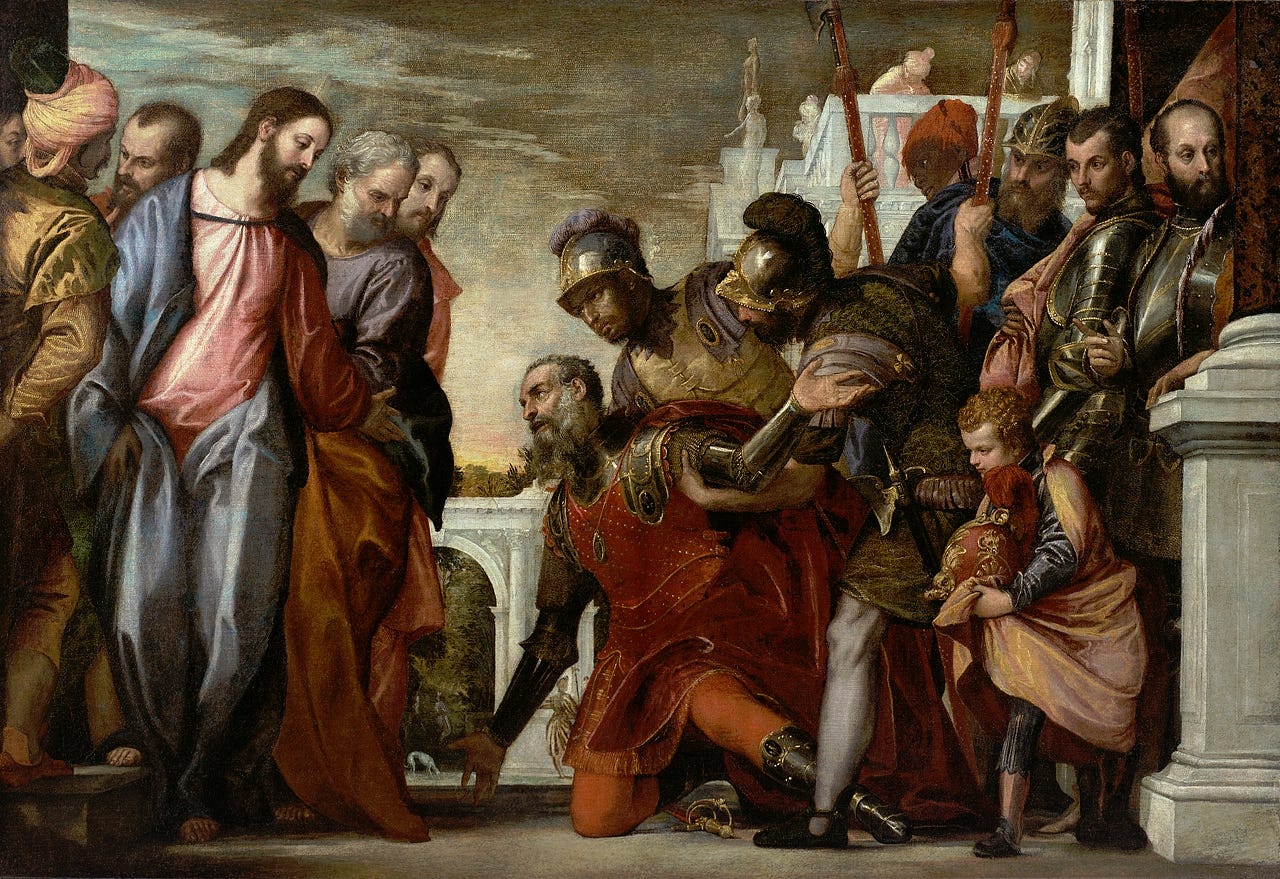
My brothers and sisters, the Holy Gospel is unquestionably filled with some of the most awesome occurrences in the history of the world. In its pages, we read again and again that those who witnessed the mighty works of Christ “marvelled, saying, It was never so seen in Israel” (Matt. 9:33). Compared with many such miracles, at first glance the one performed by Christ in today’s Gospel reading might not seem to be particularly noteworthy, or to rank all that highly in comparison to the rest. After all, in the passage we have just heard Christ did not raise the dead or cast out a legion of demons, but only healed a man “sick of the palsy” (Matt. 8:6) — an act which He likewise performed at many other times during His earthly ministry. Yet if we look a little deeper, we will see that something absolutely astonishing in fact did occur during this encounter: man did not marvel at God, but rather God marveled at man (cf. Matt. 8:10).
The person Christ healed was (as we have just heard) the servant of a Roman centurion — a military officer of pagan Rome — and it was at the faith of this centurion that Christ was struck with wonder. The most religious of the Jews demanded that Christ show them a sign before they would believe (cf. Matt. 12:38), but this pagan and stranger believed so unquestioningly in the Lord Jesus that he even refused when Christ offered to perform the miracle in his presence, saying instead: “speak the word only, and my servant shall be healed… When Jesus heard it, He marvelled, and said to them that followed, Verily I say unto you, I have not found so great faith, no, not in Israel” (Matt. 8:8-10).
We might well ask: how is it possible that this pagan centurion, being (so far as we know) completely uninstructed in the Law and the Prophets, could nevertheless acquire a faith surpassing that of God’s own chosen people — even those who had spent their entire lives immersed in His divine revelations to mankind? On the one hand, the Gospels tell us nothing about this man or his history, and we have no idea what events (whether in his life or in his soul) ultimately brought him to Christ that day in Capernaum. But on the other hand, the Gospels do tell us absolutely everything we need to know about how this man came to possess the greatness of faith at which even God Himself marveled: it was achieved precisely by means of the greatness of his humility.
Even in such a short passage, we see a multitude of ways in which the centurion’s awe-inspiring humility was displayed. This commander of the Roman army — “a man under authority, having soldiers under” him (Matt. 8:9) — did not send one of his soldiers to order Christ to come, but rather came to Christ himself, “beseeching Him” and calling Him “Lord” Whom even the soldiers under him would have viewed as hardly better than a slave (Matt. 8:5-6). And it was not for himself, or for any of his own kindred, that the centurion begged a boon from Christ; no, it was for a mere household servant that this man of rank and stature publicly abased himself. Astonishingly, the centurion then humbled himself even further, declaring before all the multitudes that he himself was “not worthy that [Christ] shouldest come under [his] roof” (Matt. 8:8). Then, in describing his simple-hearted faith that Christ could heal his servant even at a distance, the centurion referred to himself not as “a man possessing authority,” but rather as “a man under authority” (Matt. 8:9). In other words, he absolutely refused to regard the power he had been given as in any way his own.
And let us consider well, my dear brothers and sisters, that there is nothing in the world which could so surely have kept the centurion away from Christ that day as the pride which he might so easily have taken in his position. There is no greater obstacle to faith than pride, just as there is no other foundation for faith than humility. Indeed, Christ Himself spoke precisely of this when He said to the Jews: “’How can ye believe, which receive honour one of another” (John 5:44). Why is this so? Because faith is ultimately much more than mere intellectual belief (which, as most of us undoubtedly know all too well, can indeed quite easily become a source of the most pernicious pride). Faith in the truest sense means not only believing in God — for “the devils also believe, and tremble” (Jas. 2:19) — but also having complete, unfailing, and childlike trust in God. And such childlike trust is intrinsically and absolutely incompatible with pride.
It was precisely this quality of unquestioning, childlike trust — made possible by the depth of his humility — that made the centurion’s faith so great in the eyes of Christ. And it is precisely such childlike faith that we ourselves must strive with all our might to acquire — above all, through the unceasing love and pursuit of humility. The Lord Himself told us: “Verily I say unto you, Except ye be converted, and become as little children, ye shall not enter into the kingdom of heaven” (Matt. 18:3). St. Augustine — the great teacher of the Church whom we commemorate today — explains that although many of us might think this verse refers to acquiring childlike innocence, in fact this is not so (indeed, he points out that even small children can often be subject to passions of jealousy, anger, and selfishness which are quite far from innocent). Rather, St. Augustine explains this verse precisely in the context of childlike faith in one’s parents: just as young children when scraped or bruised immediately run to their mother with unquestioning trust that she will be able to make everything better, so too we must learn in everything to immediately turn to God with childlike faith that He Himself will undoubtedly take care of absolutely everything in our lives.
But to do so — truly and completely — requires a humility which remains very far from most of us sinners. Even if we desire to live a life according to God, so often we secretly (perhaps even subconsciously) strive to do so according to our own strength, our own will, and our own understanding. So often we desire not God Himself, but rather some idea of ourselves as good or loving or holy people. So often, pride and vainglory and self-love are hidden just under the surface of even the best deeds of our lives.
And this egoism is precisely the main obstacle to a true and living faith in the Lord God. We cannot fully place our faith in God as long as we still retain any faith whatsoever in ourselves. Therefore, if we wish to acquire the faith of the centurion in today’s Gospel story, we must first strive with all our might to acquire his humility.
How are we to do so? Quite simply by following the example the centurion gives to us in today’s Gospel lesson, and eagerly looking for every possible opportunity to humble ourselves before God and others. We ought even to be “greedy” for such opportunities, if one may speak in such a way. We must train ourselves to hunger and thirst for humility — and even, perhaps, for humiliations — more than we do for our daily bread, or for any of the pleasures of this vain and passing life. We must learn, with God’s help, to rejoice and to give fervent thanks for every occasion on which we are misunderstood, or mocked, or scorned, or rejected, every time we are passed over for some honor or praise, every time our opinion is ignored, every time our advice is not followed, every time someone else is preferred before us, every time we have the chance to remain silent rather than to presume that our own voice deserves to be heard, every time we have the opportunity to put someone else’s needs and desires before our own.
Why is all of this so necessary? It is not because we are supposed to develop some pathological hatred of ourselves — indeed, to do so is often merely another symptom of our fundamental self-centeredness. No, we are by no means supposed to hate ourselves; rather, we are supposed to forget ourselves, and begin to learn at long last to live purely for the sake of God and one another. But we cannot do so when we are constantly nourishing our own ego and vainglory and pride. The old man cannot be defeated if we are constantly feeding and strengthening and arming him with every possible weapon for the battle against the new man. And that is why we need to learn to cultivate a genuine longing and an active search for humility: so that gradually, little by little, we will stop being the most important thing in our own lives, and God Himself can begin to pour out the infinite and incomprehensible riches of His love and grace, without the danger that we will mistake His gifts for our own accomplishments.
And this, in turn, will lay the foundation for true faith, for complete and childlike trust in God and God alone. Such faith transforms not only the life of the one who acquires it, but also the lives of countless others: after all, the centurion became a conduit of God’s grace not only for his sick servant, but also for all the innumerable multitudes who have heard his story read from the Gospels throughout the past two thousand years. And by the grace of Jesus Christ, Who truly is “the same yesterday, and today, and forever” (Heb. 13:8), the opportunity to acquire just such a faith is being offered even now to each and every one of us. So let us emulate the centurion: let us lay aside our pride, let us put to death our own vanity, and let us eagerly seek out the humility which is the only path to living faith. And may this living faith well up in each of our hearts, until it overflows with the genuine, Christ-like, self-emptying love for which this broken world is dying of thirst, and which alone can bring the healing of all our illnesses and the salvation of our souls. Amen!
"O Lord in thy manifold mercy bestow on us a humble spirit, that our souls may find rest in Thee.
Most holy and gracious Mother of God, beseech God to make us lowly in spirit.
All ye saints who dwell in Heaven
and behold the glory of the Lord,
and your spirits rejoice-
pray that we also may be with you,
for my soul, too, would fain see the Lord, and yearns after him humbly, in
knowing herself unworthy of such blessing.
O merciful Lord, by thy Holy Spirit teach us thy humility."
St. Silouan